.2.3 Elemental sulfur
Despite its long use history (Appendix I), there remains some ambiguity about sulfur’s MOA, as both an insecticide and fungicide.
2.2.3.1 History
McCallan (Botanical Review 1949) described inorganic transformation products with possible roles in its biological effects – including oxides, pentathionic acid, and hydrogen sulfide. (He also noted the fungicidal effects of several thiocarbamate compounds including tetramethyl thiuram and the dithiocarbamate salts of sodium, zinc, and iron.)

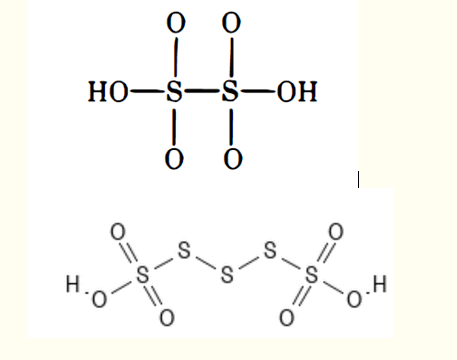
Effects of sulfur on plant defenses
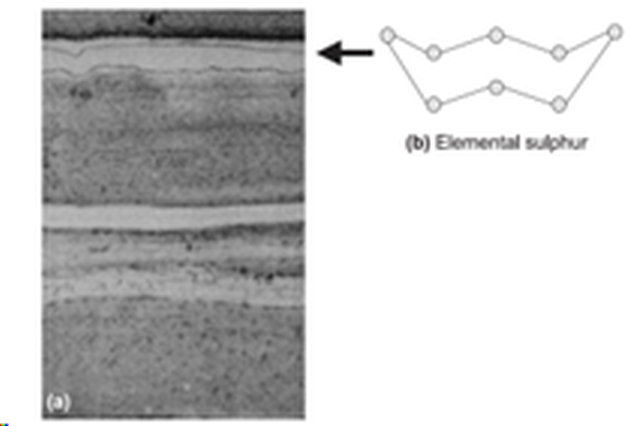
Micrographs published Williams and Cooper (Plant Pathology 1994) show that elemental sulfur forms a horizontal layer in the xylem of Theobroma cacao in response to a challenge with Verticilium dahlia. Possibly this accounts for the suggested role of sulfur as a phytoalexin, ie. a compound promoting host plant resistance. Acting as an ionophore, a similar layer of sulfur could uncouple oxidative-phosphorylation, accounting for its effect on phytophagous mites.
The IRC lists the sulfur MOA as “UN* Compounds of unknown or uncertain MOA”, although the corresponding listing for fungicides (FRAC poster 2020) classifies it as a “chemical with multi-site activity”. Available registration studies focus on sulfur’s toxicity rather than its MOA.
Use Data
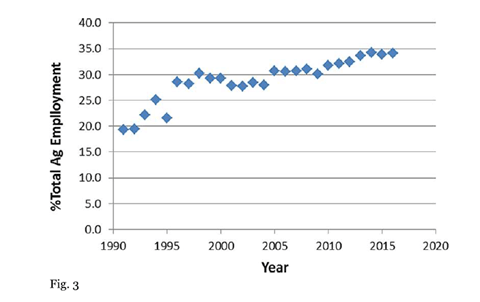
1974 use data show sulfur accounted for 28.2% of total reported insecticide use (Table 3), with records of 14166 applications, 43 separate registered products, totaling 16,093,555.8 lbs of AI. For the 10,800 records with data on treated area, the mean application equaled 3.0 lbs/acre. Sulfur still had substantial use in 2016 (35% of all insecticide use), with 48,664,569.0 lbs total (Table 4), 137 products, applied at an average rate of 7.2 lbs/acre. Applications to wine grapes and table grapes accounted for 63% of the sulfur applied (11/30/2021).
Toxicology and illness data
Animal testing reported for registration of elemental sulfur shows it has a low systemic toxicity and little capacity for causing eye or skin irritation. In agricultural use situations, transformation of minimally reactive elemental sulfur by oxidation creates moderate skin irritants.
Safety issues

Crop duster crashes and other application accidents also provoked sulfur fires (Solano 1985-1461, Kern 1990-1220; Sonoma 1991-1252; Imperial 2000-101), indicating that sulfur burns readily if an ignition source is present (Handbook of pesticide toxicology).
Illness data
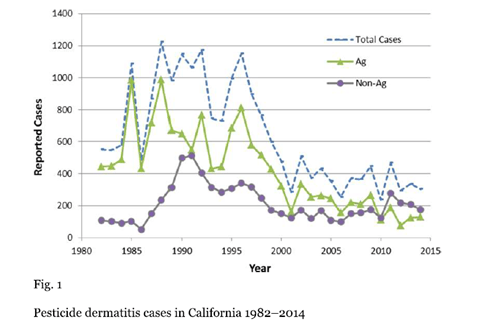
The oxidized forms of sulfur likely account for reported cases in pesticide handlers and fieldworkers. These commonly involved non-specific systemic symptoms and irritation. of the eye, skin, and respiratory tract.
The sulfur dermatitis cases included 295 difficult to classify fieldworker residue cases.
With a high average application rate and multiple sulfur applications each year on grapes and other crops, investigational routine often implicated sulfur as the most recently applied AI (see episode discussed below).
As discussed in a previous publication (O’Malley 2017 -Kanerva, Occupational Dermatology). A portion of these cases may have been attributable to propargite, a potent irritant with a very long environmental half-life.
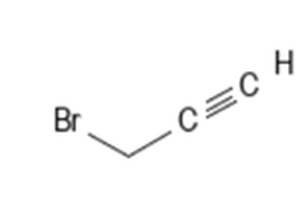

Safety issues associated with propargy bromide, Pubchem
Field residue threshold for irritation
investigation of a dermatitis outbreak among nectarine harvesters determined a task-specific“safe level” (equaled 0.2 µg/cm2) determined in a 1988 outbrtheak in orchard workers. (American Journal of Contact Dermatitis 1990). Prior outbreaks of dermatitis in grape workers, showed levels above this safe threshold
In a 1987 dermatitis episode among workers “turning cane”, residue samples showed both propargite and sulfur. Apart from 1 sample with no detectable propargite, surface (“dislodgable”) residue tests showed levels between 0.035 -0.86 µg/cm2 of propargite. Surface residue tests for sulfur showed 1.7 – 20.32 µg/cm2, with no available data on a safe level of surface residue.
Time trends
The dramatic decrease in number of dermatitis cases reported in California .corresponded with an overall decrease use of propargite. Some of the decrease could related to increases in the agricultural work force employed by labor contractors, suspected to adversely affecting illness reporting .

Allergy to sulfur
Standard animal allergy testing of elemental sulfur using the Buehler epicutaneous application method submitted for pesticide registration do not show any sensitization.
No registration studies employed the guinea pig maximization test (absorption step bypassed by injection of the test substance) or the local lymph node assay (measures lymphocyte stimulation indicated by uptake of tritium in regional lymph nodes.
Case report example
Some reported cases of dermatitis associated with sulfur suggested sensitivity (Handbook of pesticide toxicology, 2nd edition, 3rd edition) but unsurprisingly, did not have confirmation from provocation testing because of limited availability.
1987 – 174 02/28/1987 Tulare A worker complained of a rash after mixing, loading, and applying Kolospray (81% sulfur powder). He had a 2-year history of sensitivity to the material and reported that the rash occurred despite wearing complete protectiv e gear (cited in Handbook of Pesticide Toxicology, 2nd and 3rd editions)
Study of nursery workers
A patch test study of nursery workers with prior pesticide exposure showed possible allergic reactions to sulfur. Although sedentary control subjects tested negative, the circumstances of testing active agricultural workers did not exclude irritation from oxidized sulfur (O’Malley, Rodriguez, Maibach 1995).
Possible allergic reactions to sulfur transformation products
Oxidation products of sulfur include sulfur dioxide, dithionic acid, pentathionic acid discussed above, as well as sulfite compounds, frequently used as preservatives. These have received extensive evaluation
top to bottom: S8 ring structure, hydrogn sufide, hydron sulfite PCID cid 22132154 sodium sulfite cid 24437 Sodium metabisulfite CID: 656671
Sulfites present in foods and wines can cause reactions resembling allergic reactions including wheezing, shortness of breath (dyspnea), cough, rhinitis and skin reactions similar to hives.
Testing for sensitivity involves giving doses of sulfites in capsule form until symptoms appear. Possible mechanism of sensitivity include underlying asthma, and relative deficiency of sulfite oxidase (enzyme that metabolizes sulfites), No direct evidence supports IgE mediated allergy.
https://my.clevelandclinic.org/health/diseases/11323-sulfite-sensitivity
Whether sulfite allergy underlies reactions to sulfur in agricultural use remains a matter of speculation. In episodes of drift or off-site movement sensitivity to odor possibly plays a role, but often coexists with non-specific systemic symptoms and irritation of the eyes.
Case examples discussed below derive from 2010-2022 search of public California illness data (selected for off-site movement, sulfur as the only involved pesticide and a text notation regarding smell or odor).
2012 1210: A field worker did irrigation work while a crew applied dusting sulfur approximately 0.25 miles away. He smelled the sulfur and began to feel ill. Symptoms included stinging sensation in throat, blurry vision, vomiting, headache, dizziness, and nausea.
2015-1229: A worker harvesting strawberries (case from a priority episode 71-MON-15 involving 55 workers exposed to drift from an adjacent property) worker noticed a sulfur-like smell. Treating provider noted injected, inflamed conjunctiva. 28 additional workers also noted the smell of sulfur, also complaining of eye and/or respiratory irritation.
Comments:
Evaluation of irritant symptoms from sulfur usually does not present any difficulty, although it may prove troublesome to identify whether symptoms derived from a transformation product or elemental sulfur per se. Identification of sulfur allergy replies principally on clinical suspicion.
 Cholinesterase Monitoring Tools
Leave a comment