19th century India cattle poisonings, cases of deliberate human poisoning
Use of arsenic in Colonial India paralleled events in England during the “Arsenic Century”
Social Factors
According to social histories (Foreign trade and the artisans in colonial India: A study of leather Tirthankar Roy, The Indian Economic and Social History Review 1994), cattle poisoning arose out of the complicated caste system in India, Most most frequently involved the Chamars cast, operating in the rural districts of several Northern provinces. They performed hand irrigation and other agricultural labor, coarse weaving, and removing the corpses of dead cattle.
Compensation included ownership of hides from that died spontaneously. Outbreaks of rinderpest (viral cattle plague) hit Indian cattle herds in 1868 (Wikipedia, 1871 Cattle Plague commission report, conguering rinderpest article ) , with symptoms similar to those produced by arsenic. Investigators suspected poisoners took advantage of the epidemic to increase the numbers of dead cattle by administering arsenic, or native plant toxins.
Colonial police investigations provided most of the poisoning statistics, also recording cases of deliberate human poisonings with arsenic confirmed by forensic testing. Other sources included a recent blog post (Saia Prya, Word Press 2025) and a veterinary journal review published in 1883 (A. E. Queripel, M.R.C.V.S., A.V.D. Veterinary Journal and Annals of Comparative Pathology October 1883 )
1854 From H. O. TucKBB, Esq., Superintendent of Police, Benares Division, to the Magistrate of Goruckpore,-No. 144,, dated Benares, the 16th October 18H.
I have the honour to inform you that Mr. Campbell has appre-
hended 45 persons, who confess to an extended system of poisoning cattle
for the sake of their hides ; 42 more prisoners have since been appre
hended, and the system appears to be ramified throughout the whole
district
From George Campbell, Esq., Officiating Magistrate or Azimgurh, to the Superintendent of Police, the 6th or Benares Division, dated Azimgurh, the 2lst October 1854
The evidence taken in the various cases proves that 978 cattle
were poisoned, or died with all the symptoms of poisoning, in 70 villages.
Besides these there were other villages in which cattle had died suddenly
and chamars were suspected, but no proof of poisoning could be obtained
before they took alarm and concealed all traces of the crime. The number
of cattle destroyed probably amounui to several thousand, but I will
revert to this subject at the close of the report.
Even should there ‘be no very great fresh extension of the case, I calculate that I have already the means of prosecuting to conviction nearly five
hundred offenders (p 24 of commission report).
I speak of the whole of this investigation as one case, although it involves a vast number of instances, because we have already succeeded in tracing most of the isolated cases upwards to great parent stems, whence the arsenic was disseminated, and from which the whole system flowed. It appears, therefore, that the whole of the cases are of the nature of a vast conspiracy between certain leather merchants, buniahs, poison-distributors, and the village chamars who administered the drug to the cattle.
Use of arsenic as a medicine in India and other purposes
Large quantities of arsenic are consumed in the Medical College Hospital for injection into bodies intended for dissection.
The Commissariat Department purchase large quantities annually and supply it on indent to the Medical Store Department, from whence it finds its way to all military stations and medical depots throughout the country.
From Dr. C. B. Francis, Deputy Inspector General or Hospitals, Dinapore Circle, to the Secretary to the lnpector General of Hoapitals, Indian Medical Department,- No. 2369, dated Dinapore, the 19th September 1872. (p 20, p 26/124 of PDF)
- That white arsenic is used to some extent in this circle medicinally as an antiperiodic in fever (possiby related recurrent episodes of malaria) and as an alternative in leprosy. In the Patna District it is used internally in asthma and chronic bronchitis, impotency and paralysis ; its medicinal use, especially in the treatment of fever, is doubtless better known in Lower Bengal
- It is also used to some little extent as an aphrodisiac, beng sometimes taken internally, and sometimes applied exrernally as a paste
- The yellow sulphuret of arsenic (king’s yellow) is largely used, Dr. Bowser informs me, in Eastern Bengal, in the preparation of yellow paper, and mixed with quick-lime, as a depilatory for removing hair from the neighbourhood of the genital organs. It is also used with indigo in the manufacture of green paint
- The white arsenic is used for the destruction of cattlle by the chamars to a greater extent than is generally known.
Use in Arts and Industry
In arts white arsenic is very largely used by hide merchants for curing as well as protecting it from deterioration when it is transported in bales.
Painters also mix white and yellow arsenic with their paints, and pyrotechnists use only yellow arsenic.
Wood preservative
White arsenic is also used to protect ship bottoms from the attack of white-ants. It is aslo consumed largely to protect wood from destruction by white-ants by the inhabitants of Thibet and other hill districts.
It is used in large quantities by Cashmere and Umritsur shawl merchants to protect wool from destruction by worms, and to preserve the prepared shawl which is kept under cover of prepared arsenical paper. Agriculturalists and horticulturists also employ arsenic to protect seeds from worms (p 23 of commission report, p 29/124 of PDF)
Confirmed or suspected case of deliberate human poisoning
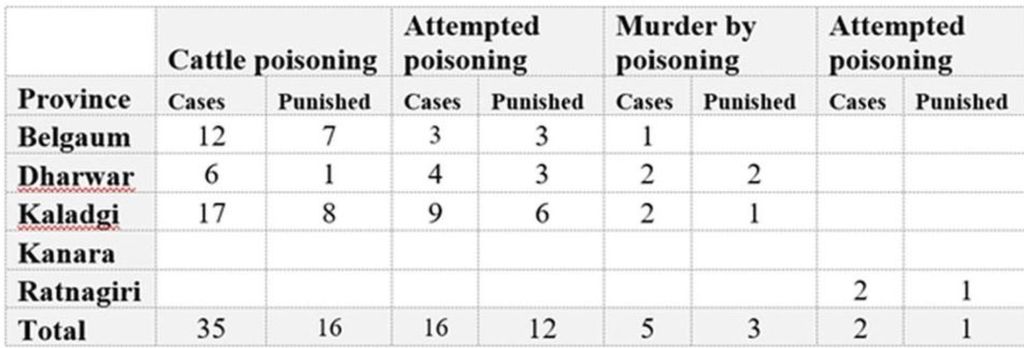
The statistics below catalog episodes of cattle poisoning and in the Bombay Province for 1880. The following section describes details of a prosecution for murder in Madras in 1875.
Statistics for cattle poisoning and murder by poisoning, Madras 1875 (p 102)
An individual case reported in 1875, clerk employed by Madras Governor
From W. Loo.Alf, Esq., Acting District Magistrate of Malabar, to the Officiating Chief Secretary to the Government of Madras,-No. 48, dated Calicut, the 25th
June 1875.
I have the honour to enclose a copy of the South Malabar Sessions
Judge’s decision in the case of Regina v. NP and KP Jr who were charged before him with the murder by poisoning of the late Sheristadar of my office, KP.
After performing his accustomed duties at this office, [KP Sr] went home in his usual state of health, took his evening meal admittedly prepared for him by the second accused, was immediately thereafter taken ill and, after a night of violent sufferings, died in the early morning.
After his death, the news of which spread consternation over the town, the idea that he had been poisoned was so scouted, especially by those who had been his most intimate friends, that Mr. C the Deputy Magistrate, who was early at the spot, consented to allow the body to be burned without a post mortem examination; and, but for Mr. C’s cautious foresight in scraping up the soil at the-places, where the deceased had vomited, it is not too much to say that the death would have been unanimously ascribed to cholera. So little suspicion was there at the time against the inmates of the house that they were allowed to go
at large and were not taken into custody until the receipt of the Chemical Examiner’s report, about a fortnight later, put it beyond a doubt that the deceased had been poisoned by arsenic .
 Cholinesterase Monitoring Tools
Leave a comment